

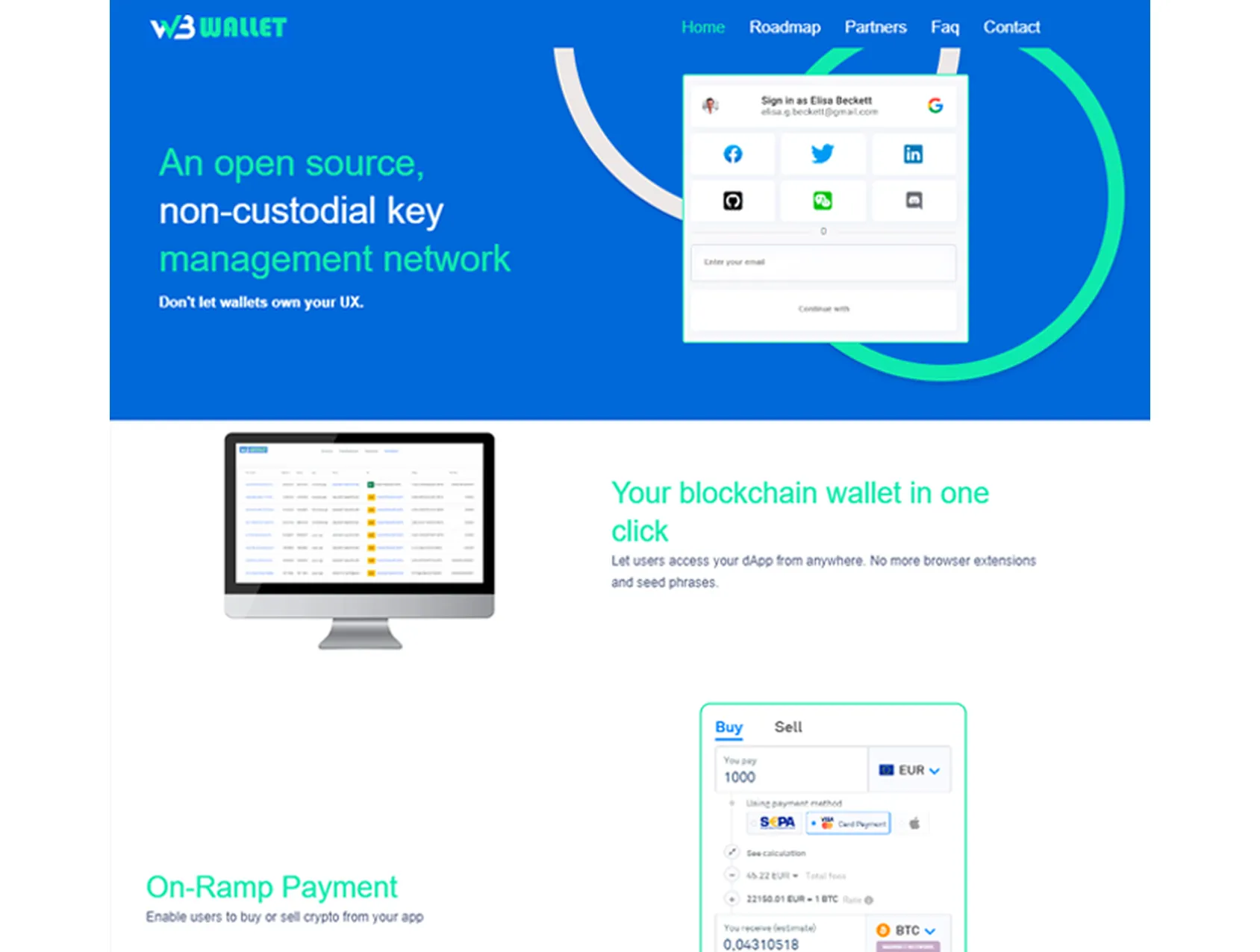
Web3 Wallet is a cryptographic wallet that enables one-click login for Web 3.0 applications. Developed for Blockchain Labs LLC, the platform removes the typical entry barrier to the decentralized ecosystem by allowing users to access it with their existing social accounts, without the need to manually manage seed phrases or private keys.
Development Challenge
The project’s main challenge was solving a fundamental problem in Web3 adoption: private key management. Traditional wallets require users to custody their own seed phrase, a process that is intimidating for non-technical users and generates a high drop-off rate. The challenge was to design a system that maintained decentralized security and custody without exposing users to the underlying cryptographic complexity.
Additionally, the system had to meet specific technical requirements:
- Multi-chain support: Unified asset management across multiple blockchain networks (Bitcoin, Ethereum, Polygon, and other EVM networks) from a single interface.
- User privacy: Integration with the TOR network for users requiring an additional layer of anonymity in their transactions.
- Performance: Transaction execution in seconds, with a user experience comparable to conventional Web 2.0 applications.
Technical Solution
MPC architecture for key management
The security core of Web3 Wallet is built on MPC (Multi-Party Computation) technology for private key management. Instead of storing the complete private key at a single point, the system splits it into multiple fragments (key shares) distributed among different participants: the user’s device, the platform server, and an independent recovery service. No single participant holds the complete key on its own, eliminating the single point of failure inherent to traditional wallets. To sign a transaction, the fragments are combined through a cryptographic protocol without the complete private key ever being reconstructed in a single location.
Social login flow
The onboarding process uses OAuth to enable access through social accounts (Google, Apple, etc.). When a user logs in for the first time, the system automatically generates the cryptographic keys associated with their account, fragments them via MPC, and distributes the key shares. The user accesses their wallet with a single click, without directly interacting with concepts like private keys or seed phrases. This flow drastically reduces the friction of entering the Web3 ecosystem.
Multi-chain integration with Web3.js
The blockchain integration layer uses Web3.js to connect with multiple networks. The system abstracts the differences between protocols, allowing users to manage assets on Bitcoin, Ethereum, Polygon, and other compatible networks from a unified dashboard. The modular architecture enables adding new networks without modifying the application’s core logic.
React frontend and Node.js backend
The React frontend provides a dashboard where users can view their assets, transaction history, and options for interacting with DeFi protocols. The Node.js backend handles session coordination, MPC protocol orchestration for transaction signing, and communication with blockchain nodes for each supported network. TOR network integration is implemented as an optional layer that routes user communications through TOR circuits, providing network-level anonymity.
Results
Web3 Wallet transformed a complex access process into a one-click experience, significantly improving the conversion rate for new users. The MPC architecture raised the security level compared to conventional wallets by eliminating the single point of failure in key custody, while multi-chain support and TOR integration provide users with flexibility and privacy in managing their digital assets.