

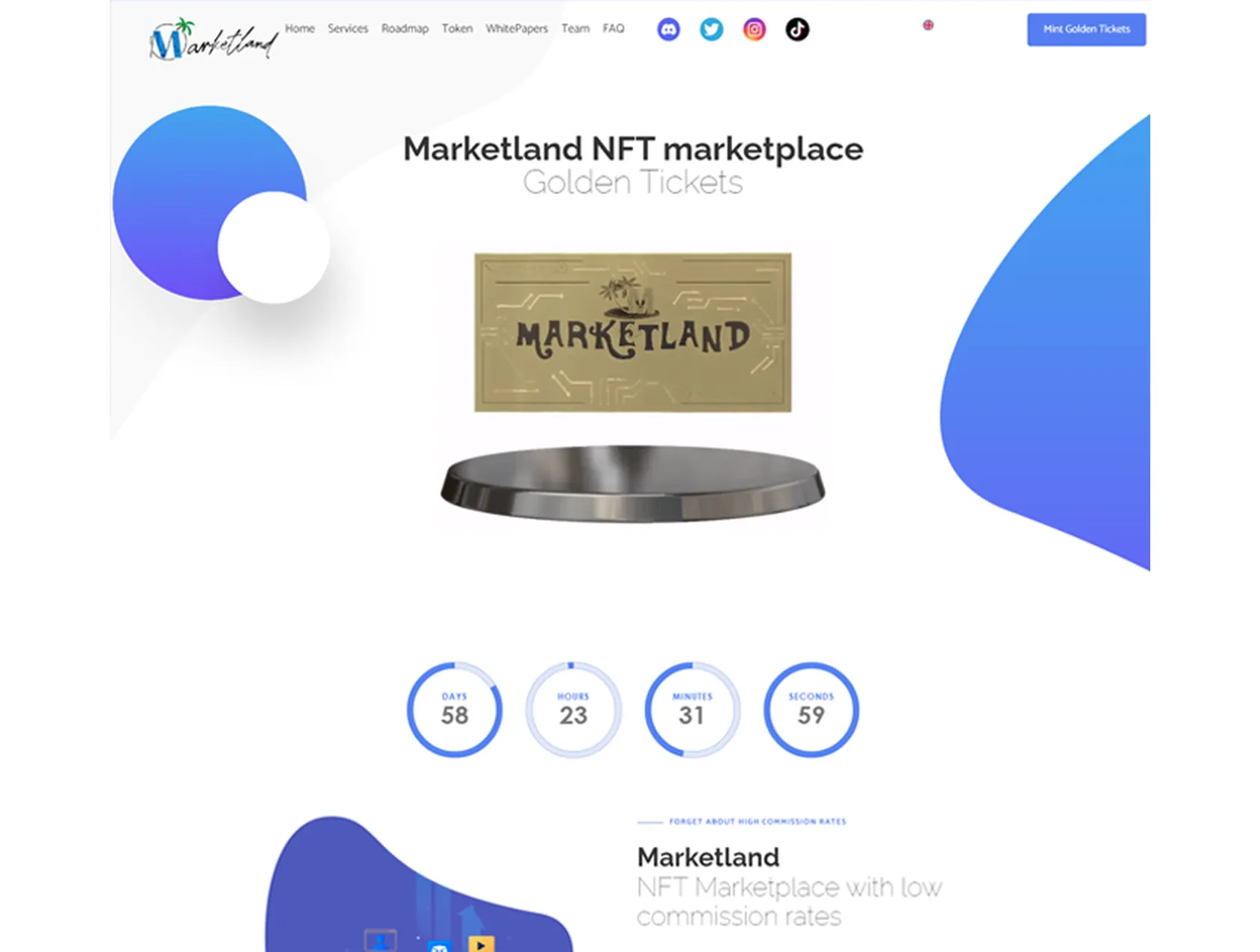
Marketland is a white-label NFT marketplace designed so that content creators, artists, and businesses can deploy their own customized marketplace without technical knowledge. The platform operates across multiple blockchains (Ethereum, Polygon, and Klaytn) and provides a complete experience including collection management, auctions, card payments, and an integrated launchpad.
Development Challenge
Marketland LTD sought to create an NFT infrastructure that could be replicated and customized for multiple marketplace operators simultaneously. The main technical challenges were:
- Multi-tenant isolation: Each marketplace operator needed their own domain, branding, and configuration while sharing the same contract and backend infrastructure to keep operational costs manageable.
- Multi-blockchain compatibility: Creators needed to choose which network to deploy their collections on, requiring contracts and interaction logic adapted to each blockchain’s specifics.
- Accessibility for non-crypto users: Most potential buyers did not have a wallet or cryptocurrencies. A credit card purchase flow was required that completely abstracted blockchain complexity.
- Launch management: Creators needed tools to configure campaigns with whitelist phases, tiered pricing, and reveal mechanisms, all from a no-code admin panel.
Technical Solution
White-Label Architecture
The platform was built with a multi-tenant architecture where each marketplace instance operated under its own domain and visual configuration. The theming engine allowed customization of logos, color palette, typography, and navigation structure through a React admin panel. Each tenant’s data was isolated at the database level, while shared smart contracts on each blockchain handled on-chain operations in a unified manner.
Solidity Smart Contracts
Modular contracts were developed and deployed on Ethereum, Polygon, and Klaytn:
- Marketplace contract: Managed direct sale listings and auctions (English and Dutch), supporting both ERC-721 and ERC-1155 tokens. The royalty logic implemented the EIP-2981 standard, allowing creators to receive a configurable percentage on each secondary resale.
- Collection factory: A factory contract enabled operators to deploy new ERC-721 or ERC-1155 collections with custom parameters (max supply, price, base metadata) through a single transaction, without requiring creators to interact directly with Solidity.
- Auction mechanisms: English auctions supported incremental bidding with automatic time extensions, while Dutch auctions progressively reduced the price until a buyer was found.
React Admin Panel
The admin panel gave marketplace operators full control over their instance: featured collection management, content moderation, platform fee configuration, and sales analytics. Creators accessed an independent dashboard to manage their collections, configure launchpad campaigns, and monitor their NFTs’ performance.
FIAT On-Ramp Integration
The NFT checkout flow integrated traditional payment gateways enabling direct purchase with credit or debit cards. The system processed the fiat payment, executed the crypto conversion in the background, and completed the on-chain transaction transparently for the user. Buyers received their NFT in an automatically generated custodial wallet, with the option to transfer it to a self-custody wallet later.
Integrated Launchpad
The launchpad module allowed creators to configure launches with multiple phases: private whitelist (verified through imported address lists), presale with reduced pricing, and public sale. Each phase included independent parameters for price, mint limit per wallet, and duration. The reveal mechanism hid metadata until the creator activated the function from the panel.
Results
The white-label architecture reduced the launch time for a new marketplace from months to days, enabling operators to configure and deploy their customized instance without additional development. Multi-blockchain compatibility offered creators flexibility to choose the most suitable network based on their cost and audience needs. The NFT checkout flow with fiat payments removed the entry barrier for buyers without cryptocurrency experience, significantly expanding the potential user base.