


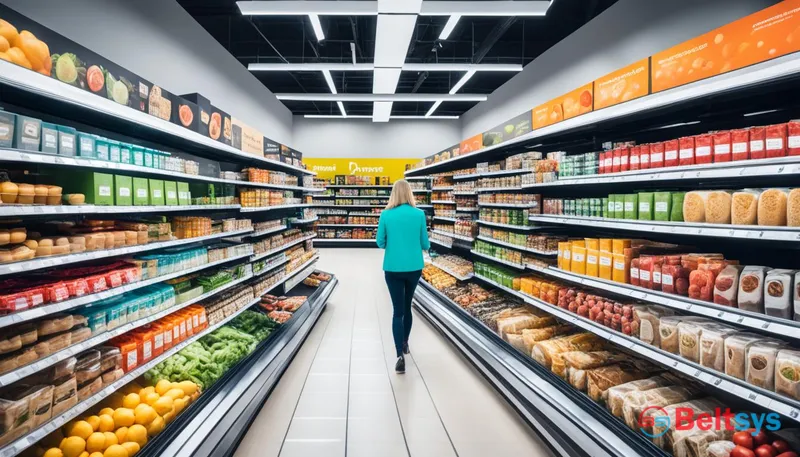
Technological innovation has transformed food retail. This is thanks to GPT4 and other OpenAI technologies. Now, AI in food commerce is used to better serve customers and be more efficient. Major companies like Walmart, Carrefour, and Alcampo use virtual assistants and algorithms to improve.
A McKinsey study says that generative AI delivers great value in four main areas. These are customer service, inventory, logistics, and sales. Walmart’s virtual assistant in Chile, for example, increased customer satisfaction by 38%. Their Text to Shop service also boosted online sales. Carrefour and Eroski are doing something similar to benefit their customers.
AI applications are not only seeking to provide a better customer experience. They also want to make the supply chain more efficient and anticipate what is needed. A good example is Alcampo’s app that creates custom orders.
Key Takeaways
- AI is changing food retail with technologies like GPT4.
- Walmart, Carrefour, and Alcampo lead with their virtual assistants and predictive apps.
- AI is greatly improving customer service, with Walmart seeing a major increase in satisfaction.
- These advances help not only the customer. They also improve the supply chain and demand planning.
- AI investment in this field is expected to grow significantly. It could reach 29 billion euros by 2028.
The AI Revolution in Food Retail
Artificial intelligence (AI) is revolutionizing the food market. The AI market in retail is expected to grow significantly. It will go from 7.14 billion dollars in 2023 to 55 billion in 2030. This shows the enormous impact of technology on this industry.
Major companies are at the forefront of this revolution. They use various AI applications and strategies in the retail sector.
Impact on Productivity and Profitability
AI strategies in retail improve productivity and profitability. Freeosk says its campaigns boost sales by more than 50%. They also attract 70% new shoppers and retain more than 20% loyal customers.
In Spain, 65% of SMEs plan to use generative AI. Already 22% have done so or are in the process. 36% of retail workers already use generative AI. This figure is expected to grow to 45% by 2025. This improves efficiency and increases profits.
Case Studies: Walmart and Alcampo
Walmart has adopted AI to be more efficient and improve customer service. They use Text To Shop to give personalized recommendations. This has increased their online sales. They also use Digit humanoid robots from Agility Robotics, showing their commitment to technology.
Alcampo optimizes shopping with orders based on customer history. This improves the customer experience and profitability. The French startup Knap works with E.Leclerc on a smart cart project. This is a major advancement in personalization and automation in the sector.
With more AI use and strategy improvements, the food sector is preparing for a technological future. AI will be key in customer service and operational efficiency.
Chatbot Applications in Food Commerce
In Spain, artificial intelligence (AI) has grown significantly in the food sector. It is now used from food production to sales. One of the most important innovations is the use of chatbots.
Improvements in Customer Service
Chatbots greatly improve customer service. They are quick at solving problems, so employees can do other things. For example, Walmart’s chatbot helps customers with various questions. Carrefour also has a virtual assistant, Carrefour Hopla, that gives advice and recommendations.
Recommendations and Shopping Personalization
Chatbots not only help the customer but also personalize shopping. They rely on generative AI services that study consumer preferences. This way, recommendations are very accurate for each customer.
The introduction of chatbots in food retail shows how AI is changing the sector. It makes operations more efficient and improves the shopping experience.
Logistics Optimization with AI in Food Retail
Artificial intelligence (AI) in food retail logistics is a game changer. Now, large amounts of data are analyzed to boost supply chain efficiency. This provides faster and more accurate responses.
Supply Chain Management
AI is key in supply chain management. It helps companies like Ocado and Alcampo improve every part of the process. It facilitates everything from warehousing to delivery, making everything more automatic and effective.
This technology helps lower costs and deliver with more precision.
Demand Prediction and Stock Replenishment
Forecasting demand is a major challenge in food retail. With AI, it is now possible to know what customers will need more accurately. The tools analyze past purchases and other factors.
This improves how stock is replenished. It reduces waste and guarantees product availability. Thus, customers have a better shopping experience.
In-Store Experience Enhanced Through Artificial Intelligence
Artificial intelligence (AI) is changing how we shop in food stores. It offers innovative solutions to improve operations and keep customers happy. It is especially useful in stockout detection and management of products nearing expiration.
Stockout Detection
Product stockouts are a major problem for stores, as customers cannot find what they are looking for. Major chains, like Walmart, use point-of-sale technologies to prevent this. Their special cameras monitor shelves and alert for restocking before something runs out.
Expired Product Management
Managing food nearing expiration is also complicated for stores. But the Wasteless system with its dynamic price labeling changes the game. It adjusts prices of products that are about to expire. This encourages customers to buy them, reducing waste. AI not only improves store efficiency but also promotes environmental care.
Use of Augmented Reality in Food Retail
Augmented reality in retail is changing how we view food products. It allows us to see products in our own space before buying them. This greatly improves the enhanced customer experience.
In Spain, in 2017, 58% of people bought online at least once a month. The previous year, that figure was 48%. Augmented reality plays an important role in this increase, blending the digital with the real.
Walmart is at the forefront with this technology, introducing it in their stores. It seeks to improve how customers experience shopping. Visualizing products at home reduces doubts and promotes better purchasing decisions.
Augmented reality can also bring discounts or unique products. This raises shopper satisfaction and loyalty.
Globally, 65% of people shop online every month. In China, that number reaches 94%. Augmented reality helps grow these numbers, optimizing how we shop online.
In the UK and Germany, 81% of users shop online monthly. This shows a strong movement toward e-commerce. Augmented reality becomes an essential tool in this shift, offering personalized experiences and added value.
In conclusion, the enhanced customer experience through augmented reality in retail transforms the food sector. It integrates digital technology improving the user-product relationship and customer satisfaction.
Artificial Intelligence in Agricultural Production
Artificial intelligence has transformed precision agriculture. Now, it is easier to manage resources and improve production. With technologies like sensors and IoT devices, crop monitoring is continuous. This provides precise information for decision-making.
Data Analysis for Crop Improvement
Companies like Agerpix and Ikos Tech are pioneers in AI for crops. Agerpix created OnFruit 360, detecting up to 95% of fruit in plantations. Ikos Tech, through Ikoscontroller and sensors, adjusts irrigation through its Raindrop app.
According to AEMET, between October 2022 and July 2023, rainfall was 15% below normal. This data is vital for adjusting agricultural practices with AI help.
Early Identification of Pests and Diseases
AI also helps detect pests and diseases before they spread. SENSOPLAG, for example, uses advanced technology to protect citrus crops. This can reduce production losses by 40%.
IoT devices and sensors work without batteries, collecting environmental data in greenhouses. This data helps farmers be more productive and efficient. AI is key in crop optimization and crop protection.
Improving Food Quality and Safety
Artificial intelligence is changing how food quality and food safety are ensured. Now, thanks to disruptive technologies in food, we can detect risks earlier. This improves food classification.
Classification and Quality Assurance
Ainia, a technology center, has made great progress in creating an information hub. This hub improves food safety. GlobalSafeFood II launched a platform with artificial intelligence to manage data efficiently.
These advances improve food quality and reduce safety issues. This is achieved by combining data from different sources effectively.
Detection of Toxic Microorganisms
The food industry uses artificial intelligence to find dangerous microorganisms earlier and with greater precision. For example, Smart4Olives improves the quality of table olives using digital twins and AI technology.
Surefish uses hyperspectral imaging technology to discover fraud in fish, such as the mislabeling of frozen tuna. These disruptive technologies in food not only ensure quality but also increase consumer trust.
Designing New Products and Beverages with AI
AI in food is changing how products are developed in the food and beverage industry. It offers unique ways to personalize products to follow consumer trends. For example, IntelligentX uses chatbots and AI to improve the flavor of its beers, based on customer feedback.
On the other hand, Analytic Flavor System in the U.S. has created Gastrograph. It is an AI platform that uses sensory data from users to create personalized foods. This technique not only improves product quality but also quickly adapts products to new consumer tastes.
Adding AI in food and quantum computing will change the sector even more. Giants like IBM and Google lead this effort, making it possible to perform complex calculations. These computers will improve the creation of new formulas and make production processes more efficient.
Additionally, projects like EatItAll, with the support of JUAN Y JUAN INDUSTRIAL, SLU and the University of Alicante, seek to personalize foods. They use advanced text analysis to meet specific nutritional needs. This effort promises significant advantages, including personalized ingredients and formulas.
In conclusion, AI in food improves how we create and adapt products according to consumer trends. It optimizes efficiency and reduces costs in the food industry. AI helps us recognize which products will be successful, improve our formulas, and better control ingredients and final quality.
Risks Associated with the Use of Artificial Intelligence
The use of artificial intelligence in the food sector offers many advantages. However, it also brings risks that we must consider. It is crucial to address AI risk management when facing these problems.
Privacy and Data Security
Privacy and data security are serious concerns. AI applications handle sensitive data, which increases the danger of cyberattacks. A Stanford University study indicates that AI can spread misinformation. This damages social trust and threatens democracy.
The lack of transparency in AI, especially in deep learning, causes distrust. This problem slows its adoption.
Bias in AI Algorithms
Bias in algorithms is another important challenge. AI ethics needs standards that prevent amplifying inequalities. Concentrated power in large companies can worsen inequality. This reduces diversity in AI applications.
AI systems can produce unpredictable results. This highlights the need to test and supervise them well. AI could replace jobs in the food industry, affecting low-skilled workers. But it can create more jobs than it eliminates.
AI dependence could reduce creativity and critical thinking. It is vital to combine AI-assisted decisions with human opinions. The social impact of AI ranges from advanced cyberattacks to the creation of autonomous weapons. This is concerning due to the potential loss of human control in crucial decisions.
More than 1,300 experts, including Elon Musk and Steve Wozniak, have called for a halt to AI development. They are concerned about safety and ethics.
Conclusion
Artificial intelligence is changing the world of food retail. It presents new ways to improve how we work and serve customers. For example, chatbots improve customer service and demand prediction helps in logistics. This means companies must adapt their strategies to remain competitive.
Integrating AI presents challenges, but working together can overcome them. Academics, industries, and governments must collaborate for safe and ethical AI development. Continuous education is important to make the most of AI in food retail. Likewise, clear laws will ensure its use is fair and safe.
In Spain, major plans are being made to use AI. The goal is to excel in science and train experts in this field. Investing in AI and adapting to it puts Spain on the path to being a leader in Europe. It also fosters collaboration with Latin America and Africa. AI is marking a before and after in food retail, being key to its future growth and sustainability.
FAQ
How is Artificial Intelligence (AI) influencing food retail?
AI is revolutionizing food retail. It introduces virtual assistants, algorithms, and augmented reality. This improves productivity and profitability.
What impact is AI having on the productivity and profitability of food retailers?
Thanks to AI, companies are seeing their online sales grow and offering better customer service. An example is Walmart, which has seen its sales increase with Text To Shop.
How are Walmart and Alcampo using AI in their operations?
Walmart uses augmented reality, algorithms, and virtual assistants. On the other hand, Alcampo improves shopping with orders based on customer history.
What improvements have chatbots implemented in food retail customer service?
Chatbots greatly improve customer service. They solve problems quickly and personalize shopping. All based on what the customer needs.
How are chatbots personalizing shopping recommendations in food retail?
Chatbots, like those from Walmart or Hopla from Carrefour, personalize recommendations. They use AI to give advice and options based on each customer's usual purchases.
What role does AI play in food retail supply chain management?
AI makes logistics more efficient. It enables better supply chain management, optimizes stock, and predicts what is needed.
How do AI applications affect demand prediction and stock replenishment?
AI predicts demand and automates stock replenishment. This helps avoid stockouts and ensures that products are available.
How are AI systems improving the shopping experience in physical stores?
For example, Walmart uses cameras to see when something is missing. Wasteless technology helps manage near-expired products better. This reduces waste.
What benefits does augmented reality offer in food retail?
Augmented reality makes shopping easier. It allows you to see products in your space before buying them. This helps make better decisions.
How is AI revolutionizing agricultural production?
AI optimizes agriculture using data to plan and manage resources better. It also detects pests and diseases early.
How is AI improving food quality and safety?
It is key for classifying foods and ensuring their quality. It also detects dangerous microorganisms early, protecting consumer safety.
How does AI help in designing new food products?
It analyzes what people prefer and market data. This creates unique products that satisfy the changing tastes of consumers.
What are the risks associated with using AI in food retail?
The challenges include data privacy and security, and the risk of bias in algorithms. It is essential to have rules and business practices that ensure fair and safe use of AI.